Saturday, April 13, 2019

Introducing Andrew and Hannah Croswell

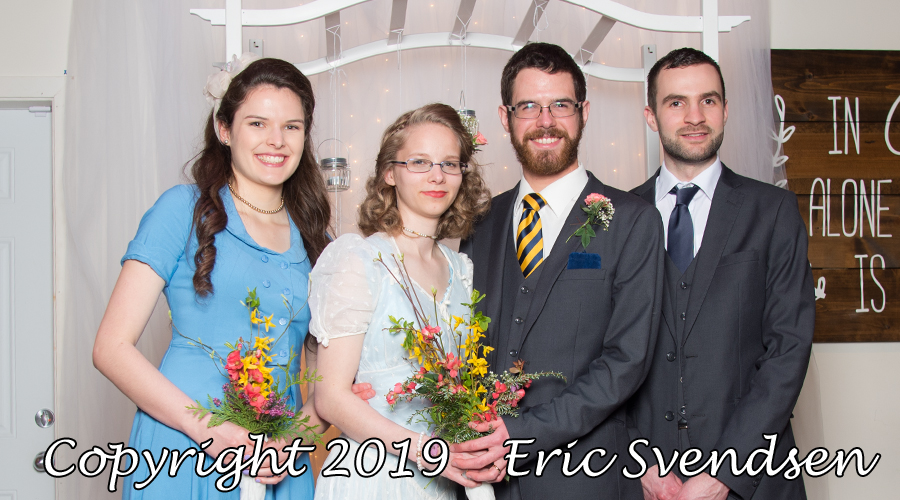
The Croswell wedding party.
Today Andrew Croswell and Hannah Musick were married at a small church in Maple Ridge.  I had the honour of photographing their ceremony and reception.  It was a small event; the church could barely hold more than 60 people.  The reception was pot luck, and there were no speeches.  What the wedding lacked in pizzaz though it made up for in warmth, charm, and plenty of love and affection. 

As a photographer my job is relatively simple; run around with a camera and photograph anything that looks like it is important.  Be there early, bring way too much equipment because you never know what you will need or what may go wrong, and help without getting in the way.  The church was small and dark and presented some difficult challenges.  Good equipment and some idea of how to use it goes a long way.  I really appreciated the effort that was put in by the family and friends of the couple to make the atmosphere attractive and easier to shoot in. 

It was wonderful to see Andrew and Hannah begin their new life together.  They were surrounded by the people that love them and that they love.  Celebrating the start of their new life together and making the whole thing fun and memorable was the theme of the day.  There was tremendous appreciation and great respect for every person present.  I am thankful that I had a chance to be part of that.

All the best Andrew and Hannah in your marriage.  You started it off right.

Sunday, March 31, 2019

Spreading cheer, wherever he goes.

Pastor Neil Penner at a Kickoff Sunday event.
You know the type.  Hard working, eager to lend a hand, and full of enthusiasm to boot.  Rare, but not unheard of.  The kind of person to bring a smile into your day, when you thought nothing would.  Someone that would help a stranger, visit you in the hospital, or lend an ear when it was needed the most.  This only begins to describe Pastor Neil.

The thing that makes Pastor Neil stand out the most certainly isn't his height.  His stature is found in his love of God and his fellow man, and his wonderfully unique character.  Spend some time around him and you will find that his sense of humor is only outdone by his ability to listen with true empathy and care.  Devoted to ministry, he arrives early and throws himself into the career he felt he was led into.  Not just a desk jockey, Neil's many assets are spread around the church as he is involved in all aspects of building the body of Christ.

Anyone who has been around enough will recognize the challenges of balancing life.  The demands of work, family, self, friends, and the plight of others all vying for what sparse personal resources are available.  The three largest factors that one has to offer includes time, energy, and money.  All those demands fill our virtual bucket.  Once it is full there is nothing to offer others, nothing left for self.  It becomes about prioritizing; filling the bucket with the most important things first.  The "bucket list," as it were, is always changing.

This is important.  The word "No" is a tool that has to be used in order to facilitate the delicate balance of those resources.  No doesn't mean "I can't" or "I don't care," it means that my bucket is almost full and I have to save something for other areas.  Use everything up at work and there is nothing for home.  The reverse is also true.  Go beyond what you can, or should do and it is yourself that pays the toll.  Our bodies are only meant to take so much stress.  After that our systems start to fail.  Slowly at first, until we are so used up that there is nothing for anybody; the bucket may never recover.

No one likes to utter that two letter dismissive.  It brings guilt to bear and we feel that we have let others down.  It is this guilt that drives people into overdoing it, into pushing beyond what is reasonable.  Outside forces drive our actions, and sometimes there are just too many of them.

I say all this because I have great respect for Pastor Neil.  Without going into details, suffice it to say that he has faced many struggles throughout his life.  Yet, he is there for others; he is always cheerful, and always doing his best.  He looks for the balance, prays for the strength, and comes up with the resources when possible.  Thankfully, Pastor Neil has the ability to say, "No."  When you hear him utter this, remember that he has done so with his bucket in mind.  It brings an entirely new meaning to the phrase, "My cup runneth over."

My bucket is full; I would love to help but cannot at this moment.  Perhaps later.  Consider waiting or maybe ask someone else.  This does not mean I do not love you, it means I have responsibilities to others and am up to what I can manage.

Thank you Pastor Neil for all your help.  Your cup runneth over, in both ways.
Monday, March 25, 2019

Tips on shooting portraits (part 2).

Kathryn and Trijnie, 2013.
The above photo is similar to the one posted on my last blog (part 1).  I used the same lens and camera type but with no tripod.  Aperture was f/1.4 and ISO 200 but shutter speed was considerably faster at 1/100th of a second because more light was available. 

The technique part of the process was mentioned but not addressed in my last blog.  My portraits range widely for technique as setting, equipment, subjects, and objective are equally broad.  What I want to do is to focus on commonalities between the previous (part 1) image and the current (part 2) image. 

If you notice both photos involve two people.  This is not a coincidence.  One of the most important things you can photograph are the relationships between people.  Certainly, it is always great to have that image of what someone looks like, especially related to some milestone, such as weddings, graduations, and so on.  But it is the relationships which we end up really cherishing.  The minimum number of people required for this is two, and the more the merrier.

When doing portraits of people, I focus on the nature of the relationships.  Key people, such as grandparents or parents should be central with children assembled around them.  Pay close attention to hands, as they represent attachments.  Stiff, down by your side hands suggest rigidness while folded arms may recommend finding a counselor.  Notice in the previous image the hands are embracing (me) while my wife’s are hidden which conveys nothing in particular.  I may have various degrees of hand holding or shoulder / arm touching, depending on the particulars.  In the above image the friends are sharing an affectionate embrace while expressing some degree of silliness.

Head position also is important.  A slight tilt of the head toward other members helps to suggest various degrees of affection.  Heads away from each other may imply less fondness.  Body position is also important, with slight twists of the torso aiding in the demonstrative impression.  Keep space tight for the same reason, and consider using objects such as chairs, attractive backgrounds, or something representing a favourite shared memory.

Finally take a number of shots as things like closed eyes, lacking smiles, or suddenly remembering some missing aspect will help improve the outcome.  Feel free to give lots of suggestions; encourage head tilts and hand placements with the constant encouragement of letting them know it will improve the shot.  If they insist on something particular, go for it, but then try a few of your own.  Let them be the judge of what they want to use in the end. 

I like to use my photography to, in some small way, improve the lives of others.  You can do the same; it only takes a fraction of a second.


Keep on shooting.

Tips on shooting portraits (part 1).

Eric and Kathryn Svendsen, 2018
One of the questions I am frequently asked is, “How did you do that?”  The answer varies greatly with the associated topic.  Sometimes the answer involves technique, sometimes equipment, and often being able to pair the two together.  The photograph above of Kathryn and I is a case in point.

The equipment part of the answer is simple; I used an APSC-sensor DSLR camera with a 50 mm f/1.4 lens and a tripod.  That was it.  Your standard DSLR camera will do; it does not have to be an advanced model.  The lens is more specific though.  I chose the 50 mm lens because it gives a modest telephoto focal length on the smaller sensor cameras.  Most portrait work benefits from mild telephoto values, ranging from 80 mm to 135 mm (relative to a full frame camera).  You can choose other focal lengths of course, but mild telephoto focal lengths are preferred by far.  The 50 mm gives a relative focal length of 75 mm on a crop sensor camera.

The f/1.4 minimum aperture is another issue all together.  Kit lenses (18 – 55 mm) will produce a minimum aperture of f/5.6 when fully zoomed in.  The higher f/value means two things; more depth of field and a lower shutter speed.  Both tend to be undesirable, especially in low light situations or using a built in flash to augment ambient lighting.  The f/1.4 lens meant I could use a low ISO (200) and a faster shutter speed, although here it was a measly 1/10th of a second.  That’s where the tripod came in, plus there was no one about to hold the camera.

That may sound somewhat paltry, but consider a few facts.  Had I used f/5.6, the background would have been more in focus, and I was going for blur to help direct your attention to the subjects.  Then there are the ISO and shutter speed issues.  F/1.4 is a full four stops faster than f/5.6.  That means the lens lets in sixteen times more light.  To get the same shutter speed the ISO would have to be 3200 which risks a lot of noise and reduces the maximum size of an enlargement you can make.  To keep the ISO at its original 200, the shutter speed would be reduced to just a bit above one second.  Hand held or not, that is a very long time for subjects that are animate. 

If you noticed there was no flash used.  I often use flash in portrait work but opted not to in this case.  A built in flash can illuminate a subject 35 feet away at f/1.4 (ISO 100) but only 7 feet away at f/5.6.  The photo was taken indoors (the background is a wall mural) and the lighting was muted.  A flash would have overexposed the foreground (the flowers), underexposed the background, and added undesirable reflections off surfaces.

Should you want to go out right away and pick up a 50 mm f/1.4 lens you will likely be disappointed because they are a bit pricey.  Weighing in at over $500, most will find it somewhat unpalatable.  However, there is good news.  The widely available 50 mm f/1.8 lens does almost the same job and is half the price brand new.  Even better is the fact that you can pick it up used for around $100 or so.  If you are serious about improving your portraits, consider getting one of these.

I will discuss other aspects of shooting portraits in my next blog.  Expect part 2 soon.


Thanks for reading.

Friday, March 22, 2019

How to say, "I love you."

Josh and Chanelle with the quilt made by Kathryn.
How do you say, "I love you," and show that you really mean it?  Words certainly convey the sentiment, but alone they may not actually convince the recipient.  Words with action are always more palpable.  This then leads to the next question, what action will impart that heartfelt expression?

There is the "Say it with flowers" concept.  This is the universal expression of affection which everyone understands.  Colours tend to play an important part with red tending towards the more amorous end of the spectrum and yellow the platonic end.  Then there is the candy method, where chocolate tends to be the gift of choice by both parties.  The nice thing about this caffeine-laced confection is that it is malleable; it can be made to take any shape.  Hearts are the metaphor for love, while rabbits may express a more miserly tone, especially if purchased just after Easter.

Cards, of course, are the most expressive of the three, allowing the purchaser to peruse through a vast array of expressive slogans to find just the right one.  This one tends to have dimorphic ramifications though.  Males will often choose or get a card with little attention to the heartfelt inscriptions while women will examine every nuance to make sure that it fulfills the intended missive.

If you want to achieve the full trifecta, you throw caution to the wind and get all three for the one you love.  Red flowers, heart-shaped chocolates, and a mushy card all have the makings of expressing that "I love you" thought which words alone may not convey.  There is something interesting here though; all of these have a commonality.  Time.

It takes time to go to these places to acquire the goods, to make an appropriate selection, and to present them with both flourish and panache.  The flowers will die, the candy eaten, and the card will experience the recycle bin.  They all took time to be delivered though, and that is the gift that tends to remain.  You took time for me.

This is where my wife, Kathryn, excels.  She likes to show her love by giving quilts.  It took almost two years - hundreds and hundreds of hours - to make the quilt she presented to her son and daughter-in-law.  That in itself is amazing, but consider that she completed it while being disabled.  Her continuous headaches prevent her from using her machines most every day; only a short window of time is available each week where she can sum-up the resources to go into her sewing room and work on her project.  Yet it has been her desire to show love in a palpable way that has allowed her to finish the task.

I can't think of a better way to say, "I love you."

Friday, March 8, 2019

Jennifer's cats

Jennifer's Himalayan cats, circa 1982    Her cats of today       My dad with a cat!
We grew up loving animals.  We did have the occasional dog in our house, but it was more the exception than the rule.  We were not really successful with that until we were in our late teens.  On the other hand, rodents and birds were quite popular.  Guinea pigs, budgies, hamsters, cockatilels, and  gerbils were all the rage.  We built sand castles and Lego forts for the four legged beasts and the two legged kinds enjoyed our constant company.  If that wasn't enough, there was whatever we could find outdoors and bring inside.  Bugs, frogs, toads, snakes; anything that could be obtained with a pair of eager hands.

Cats were never on the list of welcome creatures.  At least, that's what I understood.  My dad grew up on a farm and had a certain fondness for dogs, but I think he saw cats as the local vermin exterminators and nothing more beyond that.  My sister, Jennifer, saw them as clearly desirable, although unobtainable as a family pet.  Not that this stopped her.  She would sneak these mice-assassins into her room and hide them wherever they wouldn't be found.  I do not know how many she had over the years, but she became very good at feline subterfuge.

I consider myself fairly knowledgeable in the care of pets of all kinds but I don't hold a candle to my sister.  As an adult she has had fish, turtles, tortoises, dogs, pigeons, all matter of rodents, and the list just gets more bizarre after that.  Her favourite though, #1 top of the column best-beast-ever is the cat.  The first cat that was a "family" cat was a white Persian she named Sambo.  I have never had a fondness for cats, and this thing took a disliking to me.  I suppose the feeling was mutual.

What was funny about Sambo was that he was pretty high strung.  I suppose for a cat that is a standard order trait.  I remember he was walking on our desk and was right over the telephone when it rang.  I tell you, NASA could have saved a bundle by attaching their payloads to a freaked out cat.  Sambo lived to be 24 years old.  I was in town and dropped by my sister's to see her.  Sambo was still there.  I hadn't seen him in over ten years.  One look at me and he let out a blood curdling HISSSSS and disappeared.

Then it was a pair of Himalayans (above photo, left) and a continuous procession after that.  A couple of years ago she had to put her last cat, Cinders, down as its health had significantly declined.  He had lived to be 18.  She decided to call it quits and not get any others.  It took two days of deep sorrow and longing for her to capitulate and seek that familiar furry companionship which she had become accustomed to.  An animal rescue facility brought salvation to her grief and a new history of cat bonding began.  She has two of them as of today (above photo, center).  Their niche in her home is one of mutualism - a symbiotic relationship where both parties benefit.  They are fed and well cared for, and she gets the affection she knew as a young girl, only now she does not have to hide them.


Wednesday, March 6, 2019

Kathryn and her passion for quilting.

Kathryn in her quilting room.
I don't have a date on this image, as it was shot using slide film, which was probably some 20 years ago.  This is Kathryn in her heyday, when she was a quilting dynamo.  She finally had her craft room in our old house set up and had mastered her craft to the point that she was teaching classes on how to quilt.  The matching desk and overhead cupboards were an anniversary gift for her from me.  Her sewing machine was busily unwinding spools of thread when time was available.  Of all the crafts she has done (and there are a lot), quilting is the one she is most fond of.

As many of you know, Kathryn has been suffering with intractable migraine headaches - they never end.  They range from a level five up to a level ten.  Those big ones have only happened to her a couple of times, but they are incredibly disabling.  We went to the hospital once after she suffered with one for three days.  They had her wait in a bright, loud waiting room in a chair, which she couldn't stand.  I had to get her blankets and pillows so she could lie down on the floor with something covering her eyes.  It took hours before she was seen.  When eventually examined, the attending gave her two injections which knocked the pain down a notch.  Then she went home.  She never wants to go through that again.

Six years after the onset of those horrible migraines, Kathryn is still quilting.  The machines now are quiet most of the time as she is rarely able to use them.  Still though, when she feels well enough, it is the one place she wants to be.  It is her way of doing something meaningful.  She makes quilts for others, for the ones she loves.  A legacy of warmth and colour.  Her latest creation is traveling to Alberta where our son and his wife are.  They will be embraced by her love as surely as if she were there. 

I am a firm believer in never giving up.  Do what you can, while you can still do it.  Everybody wins.  Find a passion and follow it.  Cooking, woodwork, automotive, crafts, helping others; they all help to keep you active, engaged, and involved.   Kathryn loves quilting and helping others learn it.  I expect this to continue for as long as she is able.  My part is to support her however I can.  Making her happy makes me happy.  I think that is the way it is supposed to be.